From One Sentence to a Full Launch Pack for Irish POD Sellers
Irish POD sellers: stop losing hours to blank listing drafts. Follow this 5-stage launch pack workflow — idea to copy to pricing to content.
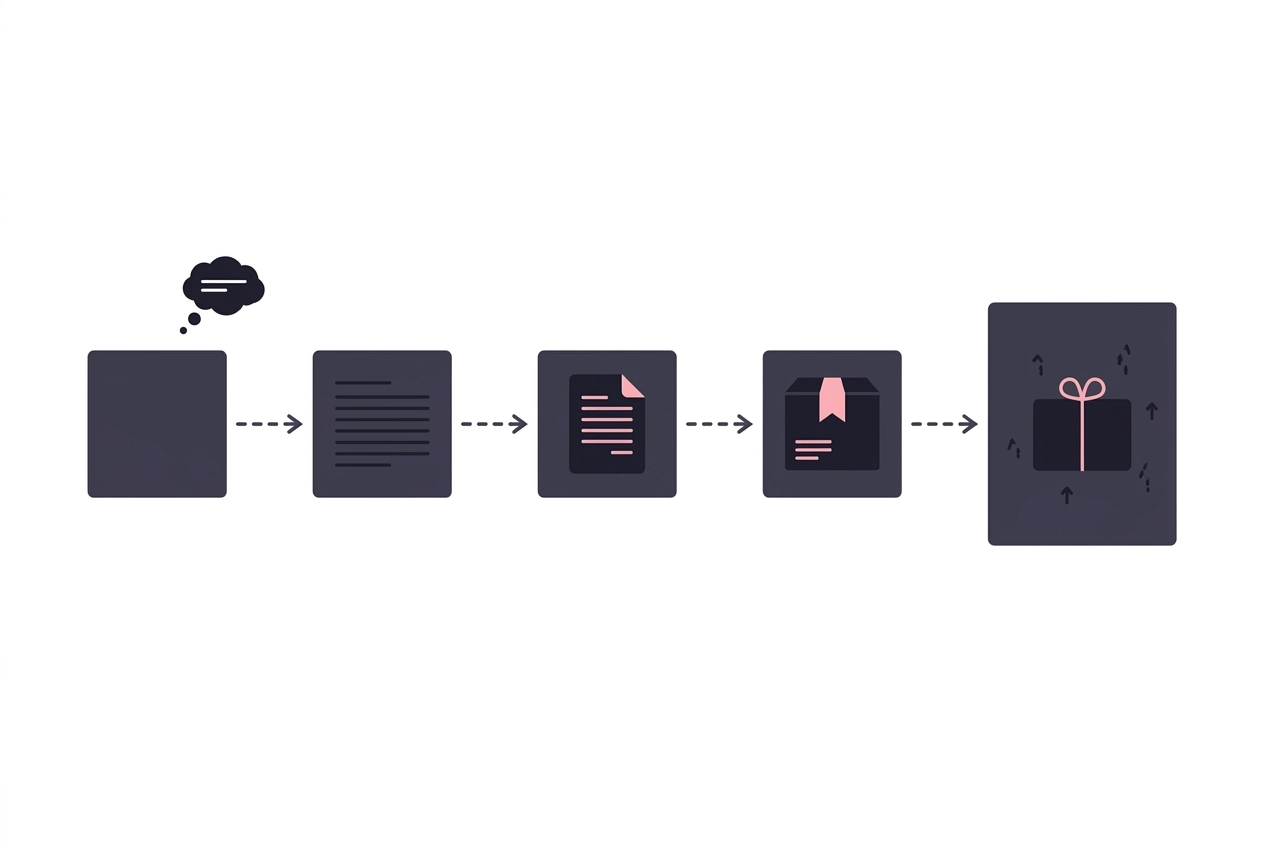
You have a great idea for a product. You can picture the design, you know who it's for, and you're genuinely excited about it. Then you open a new listing draft and... nothing. The cursor blinks. Twenty minutes later you've written three words and deleted them twice.
If that sounds familiar, you're not alone. Most people getting started with print on demand in Ireland don't struggle with ideas. They struggle with the gap between having an idea and actually launching something. That gap eats hours, kills momentum, and quietly buries products that could have sold.
This post walks you through a simple five-stage workflow that takes one rough idea and turns it into a complete launch pack, covering design direction, listing copy, pricing, and content angles. No more staring at blank drafts. No more launching "when it's ready" (which never comes).
By the end, you'll have a repeatable process you can run for every product going forward. We'll even walk through a full demo so you can see exactly how it works from start to finish. Let's get into it.
The Blank Page Is Not an Idea Problem
Most Irish POD sellers are not short on ideas. The stall happens somewhere between "I know what I want to make" and a live listing with copy, pricing, and a plan for what to post. That gap is where momentum dies.
The individual tasks look manageable in isolation: write a title, draft a description, pick some tags, work out a price, figure out what to say on Instagram. Stack them across every new product and they become a genuine drag on your catalogue. It is not a creative block. It is an operational one.
That distinction matters because the fix is different. Creative blocks need inspiration. Operational drag needs a repeatable structure.
The wider market reflects this. The European POD market is valued at USD 2.45 billion in 2025, on track for USD 3.04 billion in 2026, and growing at a 24.06% CAGR. Sellers who can compress the time between idea and live listing are better placed to build catalogue depth as that curve rises. More telling: the services segment, covering design direction, listing support, and launch optimisation, is expanding rapidly at 12.44% CAGR, one of the highest-growth slices of the market. Sellers are already looking for help with exactly this problem.
The answer is not to work harder on each individual task. It is to treat the whole thing as one connected output: a launch pack, built from a single seed idea, covering every decision needed to go live. See what that looks like in practice.
What a Launch Pack Actually Is
A launch pack is not a design file. It is the full set of decisions and copy that lets you hit publish: a design direction, a listing draft, a pricing position, and content hooks, all pulling from the same seed idea.
Most sellers on Etsy treat these as separate tasks done in separate sittings. Write the listing one evening, figure out pricing another day, think about content later. That split creates two problems: momentum breaks between sessions, and second-guessing fills the gaps.
Running them as one connected output fixes both. When your listing copy, design direction, and content angles all come from the same seed idea in the same session, the product's voice stays consistent and the decisions stay made.
A minimal viable launch pack has five components:
A focused seed idea
A design direction brief
A complete listing draft (title, description, tags)
A pricing position
At least two content angles
That is the complete picture behind the promise of one idea in, a launch pack out.
Crucially, none of these require a finished product image. Direction and copy can be locked before a single file reaches your POD provider. The product does not need to exist yet for the decisions to be made.
Stage 1: Lock the Seed Idea
The seed idea is the first component of that launch pack, and it needs far less polish than you think.
A seed is the smallest unit of direction: a niche, a feeling, a cultural reference, or a product category paired with an audience. Nothing more.
These all qualify as usable seeds:
Hiking humour for Irish trails
Minimalist coastal prints for kitchens
Sarcastic mugs for remote workers in their thirties
Notice what none of them include: a colour palette, a font choice, a finished tagline, or a product SKU. Those decisions belong to Stage 2. Dragging them into the seed stage does not improve the idea; it just delays the work.
One test to know if your seed is ready: can you say in a single sentence who it is for and what feeling it delivers? If yes, move on immediately.
"Dry humour prints for Irish weather obsessives" passes. "Something funny, maybe coastal, probably a mug or a print, not sure yet" does not.
If you are still rewording the seed after five minutes, that is procrastination dressed up as planning. The rest of the workflow sharpens the idea anyway. Write it down and move.
Stage 2: Set a Design Direction, Not a Finished File
Once your seed is ready, the next move is a design brief, not a finished file.
A design direction specifies mood, palette range, typographic feel, and layout format without requiring final art to exist yet. That distinction lets you make decisions quickly without getting stuck in execution.
For print on demand, your brief should also name the product format. Layout decisions shift significantly across surfaces: a horizontal composition that works for a wall print needs recentring for a tee, and home décor has different bleed and DPI requirements than an accessory. Noting this upfront saves rework.
Home décor is the fastest-growing POD segment at 13.7% CAGR. One seed idea briefed across wall prints, cushion covers, and totes multiplies your catalogue without multiplying your effort.
A direction brief might read: "Muted terracotta and off-white palette, hand-lettered feel, horizontal layout for prints and centred chest placement for tees, references Atlantic coastal geography without using place names."
That's enough to guide your own design work, brief a freelancer, or use an AI-assisted starting point. Any generated designs are original starting points and must be confirmed against your POD provider's technical specifications before upload.
Stage 3: Write the Listing Copy Before You Overthink It
Design direction sorted. Now copy, and this is where sellers stall longest.
Your listing has three working parts: the title (searchability and clarity), the description (voice, use case, product details), and the tags (keyword coverage without stuffing). Each one does a different job.
Title
Your title is often the first field Etsy's search matches against buyer queries, make it count by leading with the phrase buyers actually search, then add a differentiating descriptor. Keep it within the character limit and readable as a sentence, not a keyword dump.
Description
Open with who the product is for, not what it is. Buyers scan for recognition. "For the person who considers drizzle a personality trait" lands faster than "A4 giclée print on 200gsm stock." Save the product details for the second half.
Tags
Cover four angles from your seed idea: the niche, the occasion, the recipient, and the aesthetic. Want a set like this for your idea? Four angles from one sentence gives you full tag coverage without repetition.
Write the copy before you fall in love with a specific design execution. Once you are attached to a visual, you start describing details the thumbnail cannot show. The seed idea keeps the language honest.
Stage 4: Set a Price Position, Not Just a Cost Calculation
Copy sorted. Pricing is where sellers either leave money on the table or price themselves out of a sale before anyone clicks.
Base cost plus a margin percentage tells you the floor, not what the market will bear. A tightly-niched product, say, a print aimed at sea swimmers on the west coast of Ireland, carries more perceived value than a generic coastal design competing on volume. Your seed idea sets the ceiling; audience specificity justifies the number above your base cost.
For Irish sellers on Etsy with international shipping, currency conversion friction matters. A price that feels reasonable in euro can look steep or suspiciously cheap depending on the buyer's reference point. EU and US buyers have different expectations for the same item. Factor that in before you publish.
A quick note on catalogue role: Is this product meant to pull traffic, protect your margin, or anchor a gift bundle? The answer changes the price logic even when the base cost is identical. A traffic driver can sit leaner; a margin product earns its higher ticket.
One caveat: pricing guidance from any tool, including PODly, is based on stated assumptions. It is not a guaranteed margin. What's not included yet is worth checking before you lock a number. Always verify against your actual base costs and platform fees first.
Stage 5: Map Two Content Angles Before You Drop
Pricing locked. Now the second blank page appears: what do I actually post about this?
Content ideas are not a marketing plan. You need two or three angles that make it obvious what to say when the product goes live, nothing more.
Every seed idea carries at least two naturally:
The "who this is for" angle. Relatable, identity-driven, shareable. Think less product shot, more "tag someone who needs this."
The "how it looks" angle. Product in context, a note on the design thinking, or a quick process snippet.
For Irish sellers, local specificity is a genuine asset here. A caption referencing west coast weather, a particular Irish brand of stubbornness, or the gap between October bank holiday plans and reality lands differently than anything a generic POD account would post. No copyrighted material needed; the cultural texture does the work.
Keep it platform-agnostic at this stage. One post concept, one short caption hook, and a timing note. Is there a seasonal or cultural moment that makes now the right drop window? That note takes thirty seconds and saves a lot of staring later.
The payoff: your listing and your first post go live together. See a made with PODly example of how this looks when all five stages connect.
Demo: One Seed Idea Run Through All Five Stages
Demo output only. Not a real customer result, not a confirmed-compliant design, not guaranteed margin. Confirm all specs with your POD provider before uploading anything.
Here's what the five stages look like in practice.
Seed idea: "Dry humour prints for people who genuinely enjoy cold, grey Irish weather."
One sentence. That's enough to move.
Design direction (demo): Charcoal type on a warm off-white ground. Minimal illustration, if any. Single-line wit, plenty of breathing room. Format suits A4 and A3 wall prints and tote bags well, but confirm dimensions, resolution, and bleed with your POD provider before you upload a single file.
Listing copy direction (demo): Title leads with Funny Irish Weather Print and adds a specific descriptor. Description opens with: "For the person who considers drizzle a personality trait." Tags spread across four angles: the niche (funny irish gift, sarcastic print), the product type (ireland wall art, grey weather art), and the recipient (gift for irish person).
Pricing position (demo): This sits above generic wall art because the audience is tight and the gift-giving hook is clear, especially in autumn and winter. Exact pricing depends entirely on your base cost and platform fees; this example assumes neither.
Content angles (demo): First angle, a "tag someone who needs this" post; low effort, high share rate. Second angle, a behind-the-design caption about designing for the actual Irish climate rather than the postcard version. Both angles are ready before the listing goes live.
Why This Workflow Matters for Print on Demand in Ireland
That demo shows the concept in action. Here is why the underlying workflow matters specifically if you are selling print on demand in Ireland.
Germany holds roughly 23.9% of the European POD market and is packed with established sellers competing on volume. Ireland is not that. Lower competition density means a consistent drop cadence is a genuine differentiator here, not just a nice habit.
The buyer base is already there, Etsy and Shopify handle the shelf; your job is showing up consistently with products worth finding.
Irish cultural specificity, the humour, the geography, the seasonal references, the language quirks, is a largely untapped design and content asset. It does not require a large catalogue to work. It requires consistent execution, with no guarantees of any particular sales outcome.
The blank page problem costs more here than it does in bigger markets. When your total addressable audience is narrower, every stalled listing hour matters more.
A repeatable workflow fixes that. Catalogue depth compounds faster when competition is lower. The sellers who build momentum in a market like Ireland's are the ones who have a process, not just occasional good ideas.
How PODly Runs This Workflow in One Session
PODly automates this exact five-stage sequence in a single session, one sentence in, a complete launch pack out.
A few things worth being clear about before you start. The output is a starting point, not a finished file. Design directions from PODly are original creative briefs; confirm all specs with your POD provider before uploading anything. Pricing guidance is based on stated assumptions, not a guaranteed margin. Verify against your actual base costs and platform fees.
The full five-stage launch pack workflow is available now at podly.eu.
For Irish sellers running print on demand on Etsy or Shopify who want to drop products consistently, without rebuilding the process from scratch every time, PODly automates the same five stages this piece just walked you through.
Head to podly.eu. Bring a sentence. Leave with a launch pack.
Start With One Sentence
The blank page is a workflow problem. Structure it correctly and the output follows, every time.
You have the five stages now: lock the seed, set a design direction, write the copy, set a price position, map two content angles. One session. Not a week of half-starts and abandoned Google docs.
The best moment to build this habit is the next time an idea surfaces. Open a doc, write one sentence about who the product is for and what feeling it delivers, then run it through all five stages before you close the tab. That single repetition does more than any amount of planning to make it stick.
Conclusion
A blank page was never an idea problem. It was always a structure problem, and now you have the structure.
For Irish POD sellers, consistency is the edge. The market rewards sellers who show up repeatedly, not sellers who had one great idea and stalled at the listing stage.
Run one product through all five stages today. Write the sentence, work the workflow, and finish with something you can actually publish. Do it again next week.